
LT Electrical Panels are essential for safe and reliable power distribution in industrial, commercial and infrastructure facilities. A properly engineered LT panel distributes electrical power to different loads while providing protection, control and operational reliability.
LT electrical panels, also known as Low Tension panels, are used for controlling and distributing electrical power at low-voltage levels in factories, commercial buildings, manufacturing plants, data centres and various industrial installations.
In this guide, we explain the major types of LT panels, their important components, applications and key points to consider while selecting an electrical panel.
What Is an LT Electrical Panel?
An LT electrical panel is an electrical distribution and control assembly designed to receive incoming electrical power and safely distribute it to different outgoing circuits and equipment.
Depending on the application, an LT panel may perform functions such as power distribution, motor control, short-circuit and overload protection, automatic power factor correction, generator control, changeover between power sources, and process automation and monitoring.
Major Types of LT Electrical Panels
LT electrical panels are designed in different configurations depending on the purpose of the electrical system. The following are some of the most commonly used LT panels in industrial and commercial installations.
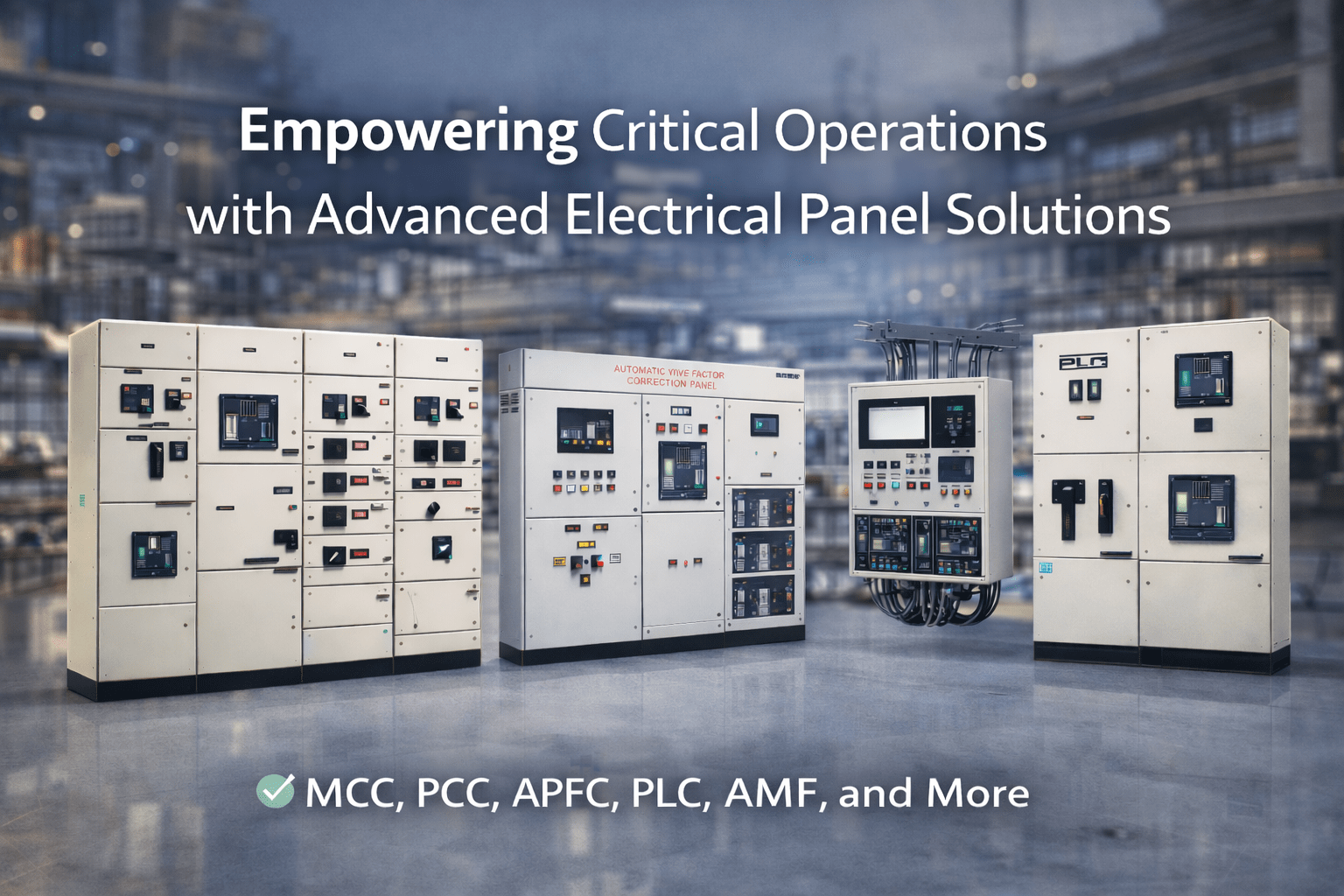
1. PCC Panel – Power Control Centre
A Power Control Centre (PCC) panel is generally used as the main power distribution panel in an industrial electrical system. It receives electrical power from sources such as transformers or DG sets and distributes it safely to downstream panels and electrical loads.
A PCC panel typically consists of ACBs, MCCBs, busbars, protection relays, metering instruments, current transformers, indication lamps and control switches. Its design depends on system current, fault level, number of feeders and operational requirements.
PCC panels are commonly used in manufacturing plants, commercial complexes, infrastructure facilities and other installations requiring reliable high-capacity power distribution.
2. MCC Panel – Motor Control Centre
A Motor Control Centre (MCC) panel is designed for the control, protection and monitoring of electric motors used in industrial and commercial applications. It provides a centralized system from which multiple motors can be operated and protected.
MCC panels may include DOL starters, star-delta starters, VFD feeders, soft starters, contactors, overload relays, MCCBs, MCBs and motor protection relays depending on the application.
These panels are widely used for pumps, compressors, conveyors, HVAC systems, production machinery and other motor-driven equipment. Proper feeder selection and protection coordination are important for reliable motor operation.
3. APFC Panel – Automatic Power Factor Correction
An Automatic Power Factor Correction (APFC) panel is used to maintain the desired power factor of an electrical installation by automatically switching capacitor banks according to the reactive power demand of the system.
Industrial loads such as motors and transformers can increase reactive power demand and reduce the overall power factor. An appropriately designed APFC panel helps compensate for this reactive power and improves the utilization of the electrical distribution system.
Major components of an APFC panel generally include an APFC relay, capacitor banks, capacitor-duty contactors, MCCBs or HRC fuses and, where required, detuned reactors for harmonic protection.
4. AMF Panel – Automatic Mains Failure
An Automatic Mains Failure (AMF) panel is used where standby power is required through a diesel generator or alternate power source. It automatically monitors the mains supply and initiates the backup source when the mains supply fails.
When the normal power supply is restored and becomes stable, the AMF system transfers the load back to the mains source and allows the DG set to shut down according to the configured control sequence.
AMF panels are commonly used in hospitals, commercial buildings, factories, hotels, data centres and other facilities where uninterrupted or reliable power availability is important.
5. Distribution Board – SPN & TPN DB
Distribution Boards are used to distribute electrical power from a main or sub-main supply to multiple final circuits and loads. They are widely used in industrial, commercial and building electrical installations.
Common configurations include SPN DBs, TPN DBs, lighting DBs, power DBs and emergency DBs. Depending on the application, protective devices such as MCBs, MCCBs, RCCBs and RCBOs may be incorporated.
The selection of a distribution board should consider connected load, number of outgoing circuits, protection requirements, phase balancing, enclosure type and future expansion.
6. PLC & Automation Panel
PLC and automation panels are used for automatic control, sequencing and monitoring of machines and industrial processes. They help integrate field devices, control logic and operator interfaces into a centralized control system.
A typical automation panel may include PLCs, HMIs, VFDs, relays, contactors, power supplies, communication modules, terminal blocks and interfaces for sensors and actuators.
Depending on the project requirement, automation panels may also be integrated with SCADA systems, remote monitoring and industrial communication networks to improve process visibility and control.
Important Components of LT Electrical Panels
A properly engineered LT electrical panel consists of several electrical and mechanical components that work together to provide safe power distribution, protection, control and monitoring.
Common components include ACBs, MCCBs, MCBs, contactors, protection relays, current transformers, meters, control switches, indication lamps, terminal blocks, control transformers and power supplies. Depending on the application, VFDs, soft starters, PLCs and communication devices may also be incorporated.
Component selection should be based on system voltage, rated current, breaking capacity, short-circuit level, operating duty, installation environment and future expansion requirements. Correct coordination between different components is essential for reliable and safe operation.
Busbar Design in LT Electrical Panels
Busbars form the main current-carrying system inside an LT panel and are generally manufactured from copper or aluminium depending on project requirements.
Busbar selection should consider rated current, permissible temperature rise, short-circuit withstand capacity, material conductivity, enclosure ventilation and installation conditions. Adequate phase-to-phase and phase-to-earth clearances should also be maintained.
In high fault-level installations, proper busbar supports and bracing are particularly important because substantial electromechanical forces can develop during a short circuit. The complete busbar system should therefore be engineered for both continuous current carrying capacity and fault withstand requirements.
Importance of Electrical Protection
Electrical protection is one of the most important functions of an LT panel. A properly designed protection system helps detect abnormal electrical conditions and isolate the affected section before significant damage occurs.
Depending on the installation, protection may be required against short circuit, overload, earth fault, under-voltage, over-voltage, phase failure, phase reversal and other abnormal operating conditions.
Appropriate selection and coordination of ACBs, MCCBs, MCBs, RCCBs, relays and other protective devices helps improve selectivity. Ideally, a fault should disconnect only the affected feeder while allowing healthy sections of the electrical system to remain operational.
Panel design should also consider applicable Indian electrical safety requirements and relevant low-voltage switchgear and controlgear standards.
How to Select the Right LT Electrical Panel
Selecting the right LT electrical panel starts with a proper understanding of the electrical system and operating requirements. Panel selection should not be based only on connected load or breaker rating.
Important design inputs include system voltage, connected load, maximum demand, transformer or DG capacity, fault level, number of incoming and outgoing feeders, motor load details, protection requirements, metering requirements and automation needs.
Future expansion should also be considered during the design stage. Adequate spare feeders, busbar capacity and panel space can reduce modification requirements when additional loads are connected later.
The panel enclosure, degree of protection, ventilation and internal segregation should also be selected according to the installation environment and project specifications.
Indoor vs Outdoor LT Electrical Panels
The installation location has a major influence on panel enclosure design and protection requirements.
Indoor LT panels are generally installed inside electrical rooms or controlled environments where exposure to dust, rain and moisture is limited. However, adequate ventilation, access clearance and temperature control are still important.
Outdoor panels require additional protection against environmental conditions such as rain, dust, humidity, temperature variations and corrosion. Suitable enclosure construction, sealing, ventilation and IP protection should therefore be selected according to site conditions.
Where the surrounding environment is particularly dusty, humid or corrosive, the material and surface treatment of the enclosure should also be considered carefully.
Why Proper Panel Engineering Matters
LT panels are a critical part of an electrical distribution system. Incorrect component selection, inadequate busbar sizing, poor protection coordination or insufficient ventilation can lead to unwanted tripping, overheating, equipment damage and reduced system reliability.
A properly engineered panel considers electrical safety, fault withstand capability, operational reliability, maintainability and ease of future expansion from the beginning of the project.
Proper documentation is also important. Single-line diagrams, control schematics, component schedules, terminal details and panel drawings help ensure correct manufacturing, installation, testing and maintenance.
Conclusion
LT electrical panels play an essential role in industrial and commercial power distribution systems. Different panel types such as PCC, MCC, APFC, AMF, Distribution Boards and PLC-based automation panels are designed to perform specific control, protection and distribution functions.
Selecting the correct panel requires careful consideration of system load, fault level, protection requirements, operating environment, automation needs and future expansion.
A well-engineered electrical panel can help improve system reliability, operational safety and maintainability throughout the life of the installation.
Need assistance with LT electrical panels, PCC panels, MCC panels, APFC panels or industrial automation systems? Contact Synergeze Solutions to discuss your project requirements.